
Where games of chance came from
Dice, cards, tiles and wheels have turned up in cultures on nearly every continent, often centuries before anyone thought to attach money to them. A quick, factual tour.
Dice in the ancient world
Dice and dice-like objects are among the oldest game pieces archaeologists have found. The Royal Game of Ur, a board game uncovered in the royal cemetery of the ancient Mesopotamian city of Ur and now held by the British Museum, is nearly 5,000 years old and was played with a set of pyramid-shaped dice. Its rules were largely unknown until a museum curator deciphered a Babylonian tablet describing them, more than four thousand years after the game was buried.
Playing cards’ long journey to Europe
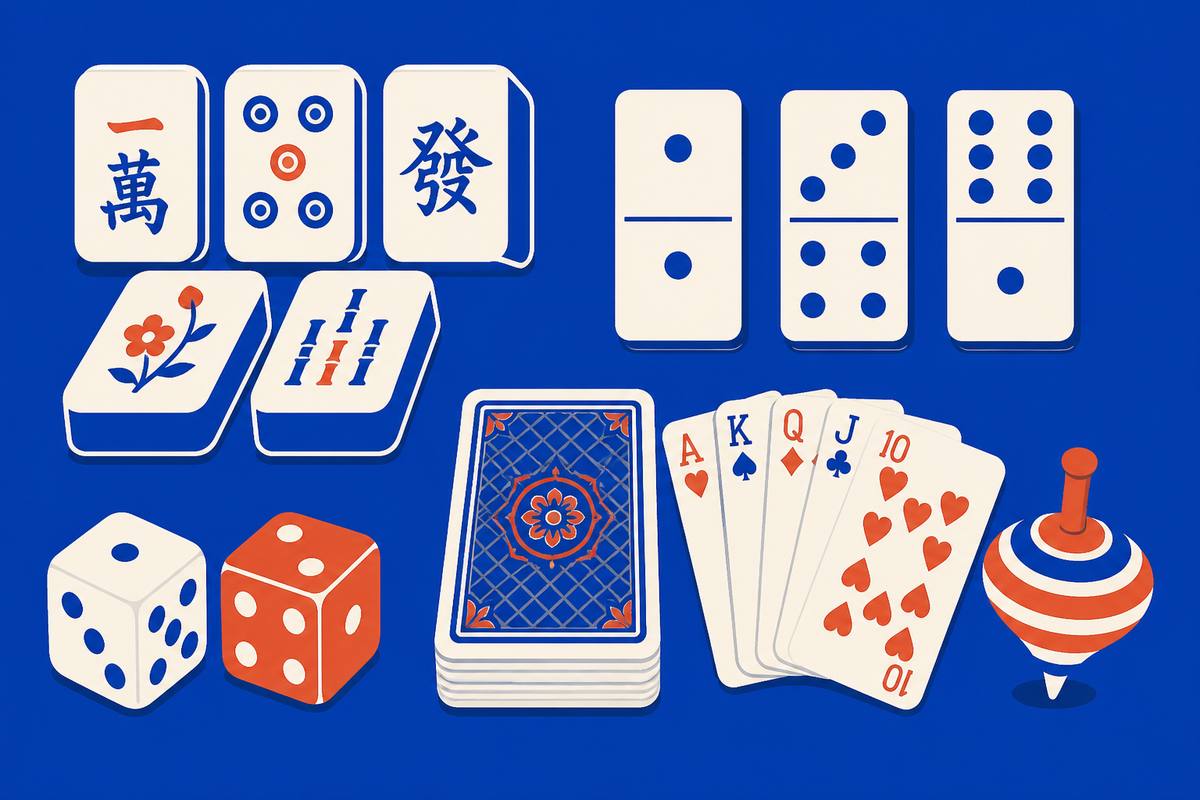
Playing cards are generally believed to have first appeared in East Asia before spreading west through the Islamic world, reaching Europe by the late 14th century. European card makers adapted the designs over the following century, and the four suits used in a standard deck today — hearts, diamonds, clubs and spades — are the French suit system that became the most widely exported version.
Tile games from China
Dominoes trace back to China, arriving in Europe by the 18th century and developing into the block-and-draw games played widely today. Mahjong, a tile game combining sets, sequences and a shared drawing pile, developed in China in the 19th century and later spread internationally, picking up regional rule variations along the way.
Wheel games in Europe
Roulette developed in France — the name is simply French for “little wheel” — and the wheel-and-ball format spread through European gambling houses in the 18th and 19th centuries before becoming a fixture of casinos internationally. The “big wheel” format that inspired our own Aurora Prize Wheel, with a set of pay categories taking up different shares of the wheel, has a similar carnival and fairground history running in parallel to casino roulette.
A more modern original: pachinko
Pachinko, a mechanical game blending elements of pinball with a vertical pin-studded board, was popularised in Japan in the 20th century and remains a distinctly Japanese entertainment format, run under its own specific local rules rather than as a casino table game.
A quick reference
| Game type | Region of origin | Core mechanic |
|---|---|---|
| Royal Game of Ur | Ancient Mesopotamia (modern-day Iraq) | Pyramid dice and a marked board |
| Playing cards | East Asia, via the Islamic world to Europe | Printed suits and ranks |
| Dominoes | China, later developed further in Europe | Matching tile pips |
| Mahjong | China | Tile sets and sequences |
| Roulette | France | Spinning wheel and ball |
| Pachinko | Japan | Falling balls through a pin board |
This is a short, general overview rather than a complete history — most of these games have long, regionally varied stories that a single table can’t capture.